
Qualcomm Previews Oryon CPU for Next-Generation Snapdragon Flagship
Ahead of Snapdragon Summit 2026 next month, Qualcomm has released an early look at three key components of its next-generation Snapdragon flagship platform, beginning with the new Oryon CPU. The preview focuses on architectural changes and memory innovations designed to boost sustained performance across common mobile workloads.
Qualcomm describes the Oryon CPU as the first mobile CPU to reach 5 GHz. For context, earlier flagship designs like the Snapdragon 8 Elite Gen 5 topped out at 4.74 GHz, and its predecessor reached 4.47 GHz. Qualcomm notes that reaching this clock speed relied on a fully custom microarchitecture and system-level engineering rather than process node improvements alone.
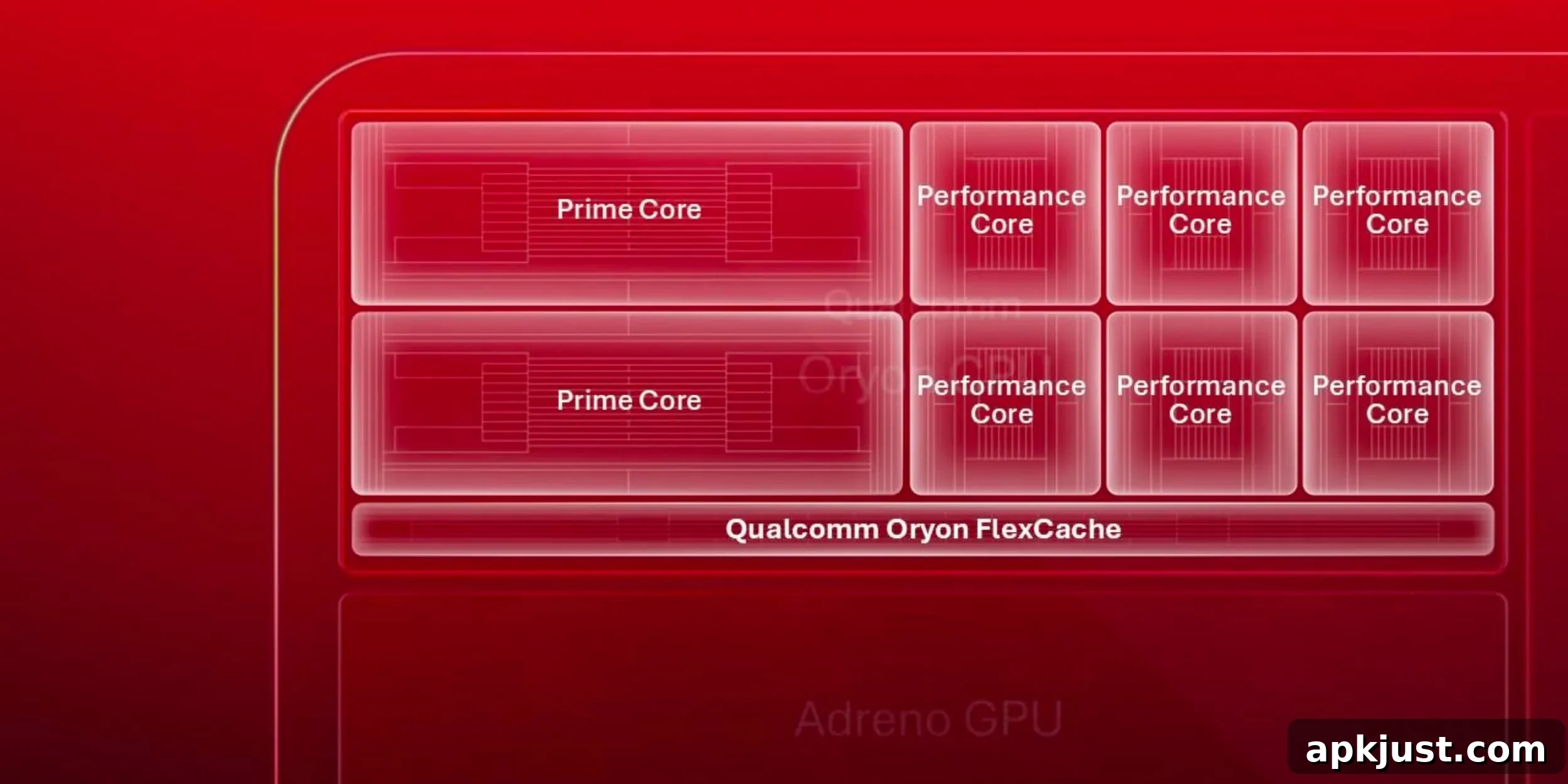
The company’s diagrams show a configuration with two high-performance Prime cores and six additional Performance cores. Beyond raw clock speed, Qualcomm emphasizes improvements in instructions per clock (IPC) and caches to ensure that higher frequencies translate into meaningful real-world gains, not just peak figures on benchmarks.
That speed is paired with exceptional instructions per clock, or IPC, so the performance shows up in real-world use cases.
Qualcomm has not shared full core-by-core specifications or the final product name yet, but it highlighted several architectural features intended to reduce wasted cycles and improve data locality:
- A larger L1 instruction cache in each core intended to keep frequently used code close to execution units and reduce stalls.
- An L2 cache placed directly in the CPU complex to provide a sizable, low-latency pool of data adjacent to the cores.
The company also introduced “Qualcomm Oryon FlexCache,” a memory architecture that lets heterogeneous cores access a shared cache pool with dynamic allocation based on workload demands. If a task requires it, the Prime cores can draw from the entire cache pool, reducing the need to access slower system memory.
Larger working sets stay resident instead of spilling to memory, so peak performance holds instead of tapering off the moment a task outgrows its share.
Qualcomm frames FlexCache as a response to industry-wide memory constraints. By keeping more data on-chip and reducing trips to system memory, cores can sustain higher throughput and avoid performance drops when working sets grow. This design is intended to improve performance consistency across several real-world scenarios:
- Agentic AI. For workflows that chain many small AI tasks or agents, a shared cache keeps datasets resident as tasks migrate between cores. That reduces cold cache penalties and keeps latency lower when agents hand off work.
- Gaming. Faster, more predictable access to local cache helps stabilize frame rates and reduce dropped frames and stutter by minimizing costly memory fetches during demanding scenes.
- Multitasking. When users switch apps or move tasks between cores, a shared cache enables warm handoffs so the resumed activity can pick up quickly without reloading large data sets from system memory.
- Video editing. Tasks such as decode, effects, and export often move data across stages and cores. Keeping frame buffers and working data inside the cache avoids repeated trips across the interconnect and preserves throughput during long processing sessions.
Snapdragon Summit will take place September 22–24. Qualcomm plans to continue its previews in the coming weeks by highlighting the upcoming chip’s GPU and NPU, which together with the Oryon CPU will define the performance profile of the next flagship Snapdragon platform.