
Following Qualcomm’s recent breakdown of the core Oryon CPU that will power its next flagship Snapdragon chip, the company has also revealed a significant upgrade to its graphics technology: the next-generation Adreno Neural Fusion GPU. This new GPU architecture brings dedicated AI acceleration directly into the graphics pipeline, enabling more efficient, lower-latency AI processing for mobile graphics and compute workloads.
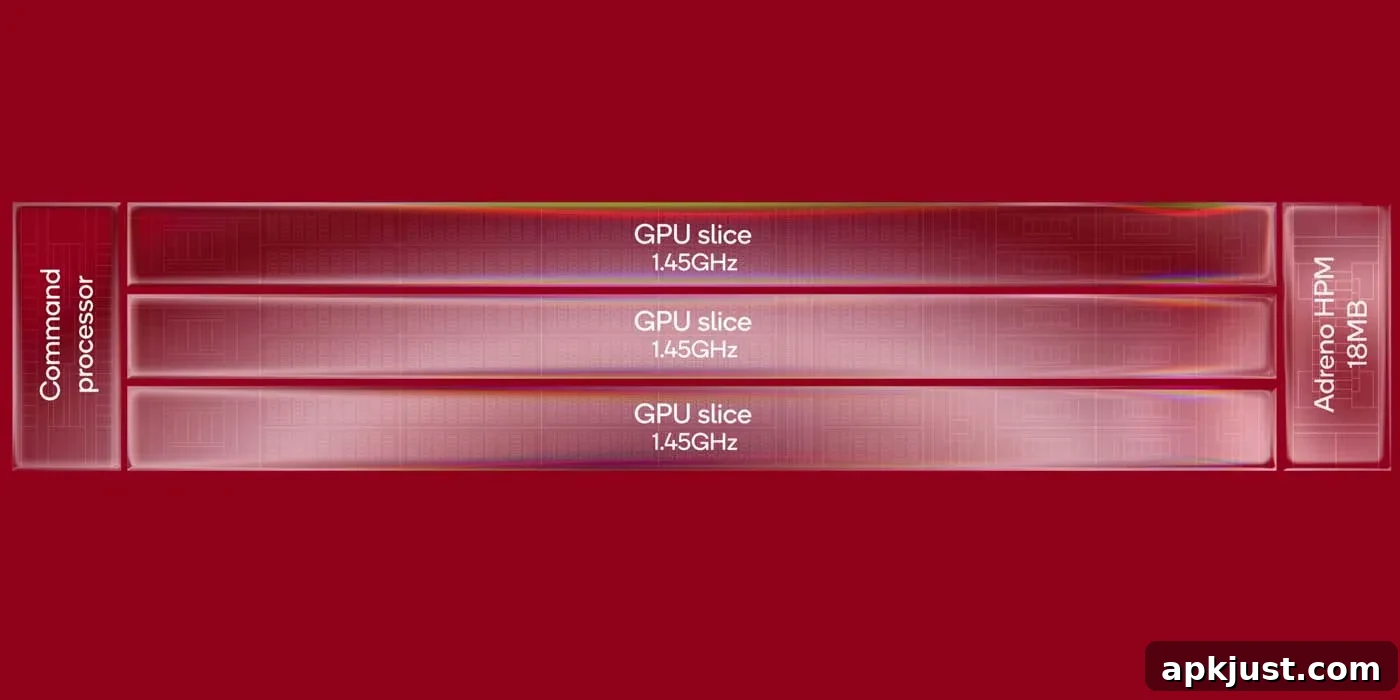
Qualcomm’s upcoming system-on-chip is the first to integrate dedicated AI GPU cores alongside the traditional graphics slices. These specialized units, which Qualcomm calls “Matrix Cores,” are embedded within each of the three 1.45GHz GPU slices on the updated Adreno GPU. The Matrix Cores are intended to run advanced AI models locally inside the graphics pipeline, reducing the need to move large data sets back and forth between the GPU and system memory.
In addition to Matrix Cores, the new Adreno GPU includes an 18MB High Performance Memory (HPM) cache dedicated to the graphics subsystem. Although 18MB may seem modest compared with general system memory, Qualcomm emphasizes that the HPM is optimized to store GPU-critical data—tile maps, frame buffers, and compute working sets—close to the execution units. Keeping this data on-chip lowers latency and reduces traffic to external memory, which helps both performance and power efficiency for graphics and AI tasks.
The trick is keeping the work close to the silicon. Adreno Matrix Cores handle AI models right where the graphics happen, and the 18MB of Adreno High Performance Memory holds the heavy data—tiles, frame buffers, compute—on-chip so it isn’t constantly shuffling back and forth to system memory. Less movement means lower latency and better efficiency, which translates into gaming sessions that last longer.
Together, the Matrix Cores and HPM form the core of the Adreno Neural Fusion GPU architecture. Qualcomm reports that by processing AI workloads nearer the GPU, the design yields substantial energy savings; in tests with the Neural Fusion-enabled pipeline, the company claims up to a 40% reduction in power consumption for supported graphics workloads. That level of improvement has meaningful implications for mobile gaming and AR/VR applications, where battery life and thermal constraints are critical.
One immediate beneficiary of this approach is game rendering. With AI models running inside the graphics pipeline, the GPU can apply sophisticated, model-driven enhancements to frames without leaving the rendering flow. Qualcomm highlights improvements such as upscaled image quality, more stable frame rates, and AI-driven rendering optimizations that reduce work per frame while preserving visual fidelity. These enhancements are performed on the GPU side, leveraging the HPM to keep tile and frame data local and minimizing costly memory transfers.
Qualcomm is already working with major game engines to support the Neural Fusion stack. Unity and Unreal Engine have integrated the necessary tooling and runtime hooks to take advantage of Adreno’s AI-enabled pipeline, which should make it easier for developers to adopt AI-enhanced rendering techniques without redesigning their rendering engines from scratch. This integration helps accelerate developer adoption, enabling a smoother path to improved visuals and efficiency in many existing and upcoming titles.
Beyond gaming, the new GPU architecture will also benefit other graphics-intensive and AI-driven use cases such as image and video processing, real-time effects in augmented reality, and interactive compute tasks that demand both low latency and high efficiency. By placing AI inference closer to the graphics execution units and maintaining a dedicated high-performance cache, Qualcomm aims to deliver richer experiences on devices while keeping power consumption in check.
Qualcomm plans to share more details about the full Snapdragon platform—including the NPU and additional features—at the upcoming Snapdragon Summit scheduled for September 22–24. With the Adreno Neural Fusion GPU, the company is emphasizing a tighter fusion of AI and graphics hardware to meet the growing demands of immersive mobile experiences and next-generation applications.
For readers tracking the platform’s CPU developments, Qualcomm also published a technical overview of the Oryon core that will appear in the same flagship Snapdragon family. Together, the CPU, NPU, and the Adreno Neural Fusion GPU represent Qualcomm’s vision of a more integrated, AI-centric mobile SoC designed to deliver higher performance, greater efficiency, and new capabilities for developers and users alike.