
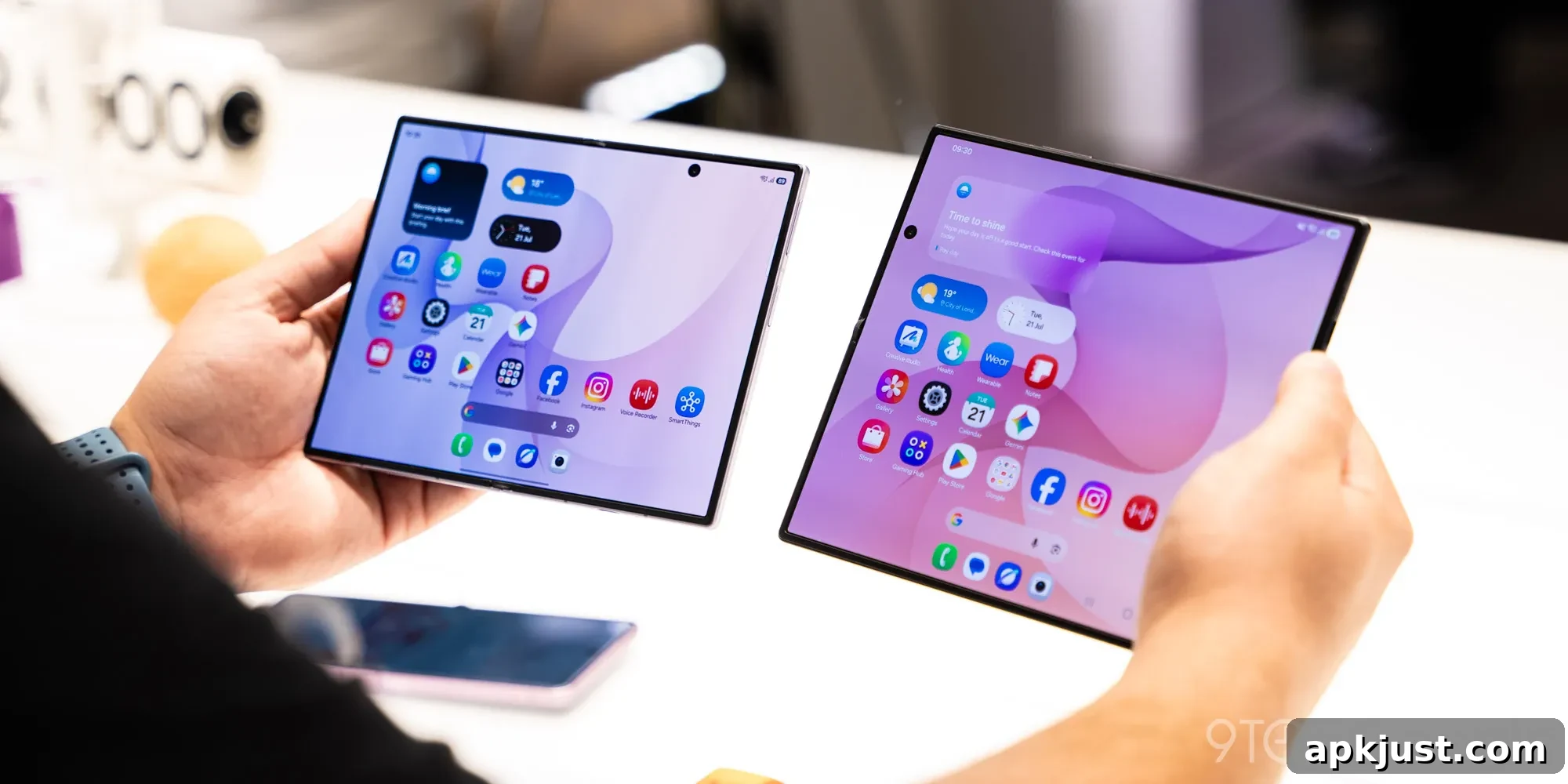
Android continues to be a diverse platform, and that diversity is emphasized with Samsung’s new Galaxy Z Fold 8 series. Google describes the Fold 8 as an “ultra-wide foldable,” a form factor that presents fresh design challenges and opportunities for app developers.
In a developer-oriented post, Google urges Android app creators to move beyond assumptions about fixed display orientation and size. Ultra-wide foldables offer a much wider canvas but often a reduced vertical height, and few existing apps were built with those proportions in mind. While some earlier devices fit this category, the Fold 8’s width and multi-state behavior make it especially important for developers to reconsider layout and interaction strategies.
To help apps adapt to these new devices, Google recommends using responsive, adaptive layouts and tracking the actual display space an app occupies. This approach ensures consistent, usable interfaces across single-screen, multi-window, and split-screen modes. Developers are also encouraged to take advantage of fold-aware features, allowing an app to intelligently split content around a hinge or fold point rather than forcing awkward or clipped UI elements.
- Build fluid, adaptive layouts: Wide aspect ratios and limited vertical space call for flexible UIs that scale smoothly. Developers should evaluate the window width first to decide on layout changes, then refine those arrangements based on height. Structure layouts using flexible containers so content can wrap, span, and reflow naturally as the available space changes. Reference implementations and sample galleries can provide practical patterns and visual examples for adapting components to ultra-wide and dual-screen contexts.
- Track actual app space: The space an app uses is not always the same as the physical device screen size, especially when users run multiple apps or enable split-screen and multitasking. Orientation can also change dynamically. Use window size classifications and the platform window management APIs to determine the precise dimensions available to your app in real time, and adapt your UI accordingly.
Google also highlights camera considerations on foldable phones. Apps that expect a fixed portrait orientation for an unfolded device can end up with sideways, stretched, or cropped camera previews when the device transitions between folded and unfolded states. Camera handling should account for the physical placement of sensors and how preview windows resize or reorient during folding. Using camera libraries that support rotation and dynamic preview sizing helps ensure a reliable capture experience across states.
The developer guidance reiterates that the latest Galaxy Fold devices include new on-device capabilities and updated platform integrations. These devices arrive alongside other hardware and software updates that affect app behavior, such as improvements in on-device intelligence and updates to wearable integrations. Developers should test their apps on actual hardware or accurate emulators that simulate hinge positions, wide aspect ratios, and multi-window combinations to identify layout issues early.
For users, the Galaxy Z Fold 8 is available for pre-order, and early adopters will see how apps handle the novel display proportions and fold transitions. For developers, the launch represents both a challenge and an opportunity: rethinking layout, input, camera handling, and multitasking support can lead to better, more polished experiences on foldable and dual-screen devices.
More on Samsung:
- Samsung adjusted the Fold 8 hinge to make opening and closing noticeably easier, improving everyday usability.
- The Fold 8’s wider shape changes how videos and other media are presented, which may require designers to revisit aspect-ratio handling and immersive modes.
- New screen coatings and anti-reflective treatments improve visibility in bright environments, enhancing readability on the expansive inner display.
Follow Ben: Twitter/X, Threads, Bluesky, and Instagram