
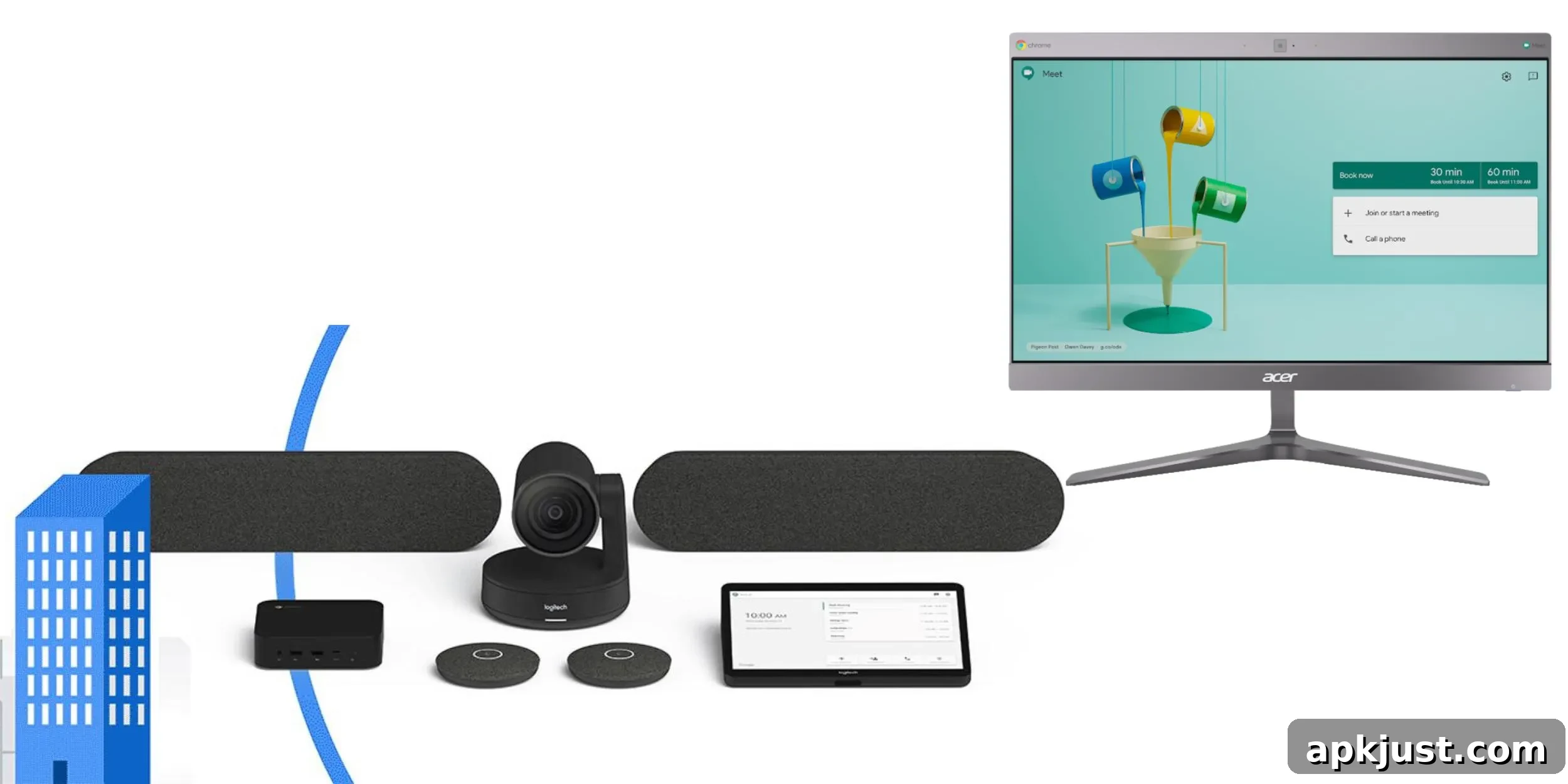
As we wait for the consumer launch of Googlebooks, Google announced today that it is transitioning its Google Meet hardware portfolio from ChromeOS to Android. The change will affect the operating system that runs the room kits, touchscreen controllers, and compute systems that power video conferencing in meeting rooms.
Current Google Meet hardware includes touchscreen controllers, cameras, microphones, speakers, and a small compute unit—often a Chromebox—that hosts scheduling software and the meeting application. Going forward, Google plans to replace ChromeOS with Android as the primary platform for these devices.
Google emphasizes that existing ChromeOS investments are protected. Devices already deployed and supported on ChromeOS will continue to receive security patches, stability fixes, and full ChromeOS releases for the duration of their support window. For recent models, that support remains in place through 2030, and Google says there are no immediate changes to established support timelines.
Hardware partners including Logitech, CTL, and ASUS will phase out production and sales of ChromeOS-based Google Meet compute systems according to announced timelines. The specific end-of-manufacture dates shared by Google are:
- Logitech / CTL Google Meet Compute System: February 2027
- ASUS Google Meet Compute System: April 2027
For customers looking to purchase ChromeOS devices to complement their existing fleet, particularly for large event spaces, we encourage you to purchase devices as soon as possible.
This switch to Android aims to broaden hardware choices and offer additional flexibility for organizations provisioning meeting spaces. Google lists several benefits of Android-based Google Meet hardware:
- Device variety: Android-based room hardware supports a wider range of form factors. Options can include compact all-in-one units, video bars, and integrated room solutions suitable for focus rooms, huddle spaces, and large boardrooms. The broader device selection helps organizations match hardware to room size and use case.
- Enterprise stability: Google states that Android devices for rooms will deliver the performance, responsiveness, and reliability enterprises expect from ChromeOS devices, while leveraging the Android ecosystem.
- Hardware flexibility: Certified Android AOSP devices can support multiple video conferencing solutions. That compatibility helps protect long-term investments by allowing rooms to be repurposed for different conferencing platforms without wholesale equipment replacement.
- Long lifecycles: Devices certified for Google Meet are engineered for durable hardware and predictable software support, aligning with enterprise expectations for lifecycle management and reduced total cost of ownership.
Google also teases several Android devices planned for large-format spaces, with product introductions targeted for 2027. For organizations planning new purchases or seeking to expand their existing fleets, Google’s announcement signals a shift in platform strategy while reaffirming support for ChromeOS devices already deployed.
In practical terms, IT teams and procurement managers should review their room hardware roadmaps. If ChromeOS-based compute systems are a requirement for specific integrations today, ordering decisions should account for the manufacturing phase-out windows announced by partners. At the same time, teams can begin evaluating Android-based options that promise broader form factors and flexibility, especially for future-proofing meeting-room investments.